Yesterday, Erika wrote this insightful post, titled Questioning the Five Paragraph Essay. This was my first visit to her blog, and I'm glad that I ventured outside of my group to check it out because her ideas have really got me thinking.
I'm in the same place with respect to her observations of formula writing in school. The five paragraph essay isn't real world writing nor the type of writing that real writers do. At least, I've never heard someones say, "I am a writer and I specialize in five paragraph essays." And like Erika also brings up, this formula-based approach to teaching writing serves to create a mindset in students that counters their identity development as writers. Writing becomes nothing more than a formal task, artificial, with an image in place of what it should look like before the first word even gets written.
I know that good writing isn't taught with a formula, but Erika's post, along with with some of the ideas from Ben's demo yesterday, has got me doing some more thinking about why such an approach is even used at all.
My first thought was that practices like the five-paragraph structure, or the "hamburger outline," may have something to do with a combination of how we traditionally view learning in school and that teachers of writing may not be writers themselves. When you write often, you learn what writers need, you see how writing happens and develops. That the steps of the writing process happen in the order by which they need to happen and build on themselves. It's sort of a mess, and it's a process that doesn't fit neatly into how stuff traditionally gets "taught" in school:
.....Teacher with the knowledge, the right answer, guides students in predetermined learning outcomes.....The whole broken down into more easily learnable chunks for teaching.... Rote, low level tasks must be mastered before moving on to the advanced....
It's a model that I think is built on a paradigm of right answers and linear progress. The formula, and even the corresponding rubric, are pieces that make work together to support an image of good writing that is objectifiable, teachable.
But Nick's "bad writing demo" has got me wondering if the formula writing approach has more to do with creating a definition of bad writing than it is defining the good. That creating this definably bad writing may be the piece that is most detrimental to teaching writing. Sure, I guess that the two concepts are polar and that one can't exist without the other...But when bad writing becomes something that can be defined, the formula enacts greater power and control. We fear being told that our writing is objectively bad. We steer clear of breaking the rules, making a mess, exploring new ways to craft meaning, and thus don't engage in the tasks of carving identities as writers.
I've been here before. I've been the students Erika describes who asks for the minimum number of paragraphs. Actually, I've written so many formula essays that I got pretty good at them.
It wasn't these experiences, though, that let me to say that, "yes, I am a writer." It wasn't until years after I began teaching that I was able to say this.
I am wondering now not just about the conditions that writers need to grow, but also the practices that would against the years of fear created through formulas and hamburger outlines.
Friday, July 12, 2013

Tuesday, July 9, 2013
Unpacking grammar and rethinking conventions instruction in school
Lots of good thinking happening today, but Lacy's session on grammar at the end of the day really got my mind going. Actually, I don't think that I have ever been in a room of English teachers (or mostly English teachers), and didn't have an interesting conversation when the subject was grammar. The point that started my line of thinking happened when as a group we were just saying aloud words/phrases that we connected to our thoughts and experiences with learning and teaching grammar.
Someone said that the word "overlooked." I'm not sure who. Nor am I sure what it was in reference to with respect to grammar or that person's experience with grammar. The word brought to my mind, though, the countless complaints I've heard (from both teachers and the greater society) about students and their knowledge of standard gramatical usage:
"The grammar in these students' papers is terrible,"
"Students today just don't know grammar,"
"How are students able to get through school with such poor grammar?"
"Texting is destroying the ability to communicate."
Whenever any of the above comments are made, others in conversation agree. They are simple statements, and usually those making them see truth in the words, plain as day.
But Lacy's demo got me to continue some thinking that I have already been doing around the subject of grammar and school, thinking that has let me to see that what on the surface appear to be simple observations about the state of language today by youth speakers, the reality is much more complex. Criticisms of grammatical usage are statements laden with beliefs about culture, language, and schooling.
The concept of grammar is huge, and when people talk about grammar I'm pretty sure they are referring to the rules that govern usage in our language. And most commonly it's in reference to usage in the standard dialect, since any dialect of English has its own rules that govern usage. I'd venture to guess that most people who hate on the conventions of people's language would agree with the unpacking I'm doing here about what is really meant by the "poor grammar" type comments I've mentioned here.
But I've got to wonder why, though, people tend to get so fired up about people not following the rules of the standard dialect. Heck, this standard dialect only exists in written form, nobody speaks it perfectly, and even in it's written form, there are all sorts of disagreements about the rules, rules which get rewritten all the time.
You wouldn't think that something that is so fluid, diverse, and well...arbitrary would draw out reactions of much consequence, but in our society it's the norm to use the way people speak and write to draw conclusions about their intelligence, education, hygiene upbringing, and even morality.
And it may or may not be true that those who feel so strongly about grammar in school do so because they believe the connection between usage and intelligence. Perhaps it is the good intentions of people who want children to have opportunity in life and to be free from these ridiculous judgements that causes grammar instruction to get the attention that it does in school.
I think that it's likely the latter, because as is often the case, our good intentions blind us to the possibility that our actions and beliefs may adversely affect our cause. Language is deeply personal, and placing greater value on the dialects of some and devaluing others creates an injustice in opportunity and the conditions that feed marginalization.
So, here's where I am now. I'm not saying that students should leave school without a command of the conventions of standard usage. That would be stupid. It's the dialect of power, politics, and academia...like it or not. That's reality, and it's generally agreed upon. But when it comes to talking about grammar and taking a constructive approach to teaching grammar, I feel like the dominant narrative has much to be disagreed with. I'm wondering now about what teaching practice looks like that gives students this command of standard conventions without devaluing their language practices or the intricacies and flexibility of our language. Lacy's demo gave me an image of possibility where grammer offered a space to be inquired into, rather than preached, and I feel like that is definitely a step forward.
Someone said that the word "overlooked." I'm not sure who. Nor am I sure what it was in reference to with respect to grammar or that person's experience with grammar. The word brought to my mind, though, the countless complaints I've heard (from both teachers and the greater society) about students and their knowledge of standard gramatical usage:
"The grammar in these students' papers is terrible,"
"Students today just don't know grammar,"
"How are students able to get through school with such poor grammar?"
"Texting is destroying the ability to communicate."
Whenever any of the above comments are made, others in conversation agree. They are simple statements, and usually those making them see truth in the words, plain as day.
But Lacy's demo got me to continue some thinking that I have already been doing around the subject of grammar and school, thinking that has let me to see that what on the surface appear to be simple observations about the state of language today by youth speakers, the reality is much more complex. Criticisms of grammatical usage are statements laden with beliefs about culture, language, and schooling.
The concept of grammar is huge, and when people talk about grammar I'm pretty sure they are referring to the rules that govern usage in our language. And most commonly it's in reference to usage in the standard dialect, since any dialect of English has its own rules that govern usage. I'd venture to guess that most people who hate on the conventions of people's language would agree with the unpacking I'm doing here about what is really meant by the "poor grammar" type comments I've mentioned here.
But I've got to wonder why, though, people tend to get so fired up about people not following the rules of the standard dialect. Heck, this standard dialect only exists in written form, nobody speaks it perfectly, and even in it's written form, there are all sorts of disagreements about the rules, rules which get rewritten all the time.
You wouldn't think that something that is so fluid, diverse, and well...arbitrary would draw out reactions of much consequence, but in our society it's the norm to use the way people speak and write to draw conclusions about their intelligence, education, hygiene upbringing, and even morality.
And it may or may not be true that those who feel so strongly about grammar in school do so because they believe the connection between usage and intelligence. Perhaps it is the good intentions of people who want children to have opportunity in life and to be free from these ridiculous judgements that causes grammar instruction to get the attention that it does in school.
I think that it's likely the latter, because as is often the case, our good intentions blind us to the possibility that our actions and beliefs may adversely affect our cause. Language is deeply personal, and placing greater value on the dialects of some and devaluing others creates an injustice in opportunity and the conditions that feed marginalization.
So, here's where I am now. I'm not saying that students should leave school without a command of the conventions of standard usage. That would be stupid. It's the dialect of power, politics, and academia...like it or not. That's reality, and it's generally agreed upon. But when it comes to talking about grammar and taking a constructive approach to teaching grammar, I feel like the dominant narrative has much to be disagreed with. I'm wondering now about what teaching practice looks like that gives students this command of standard conventions without devaluing their language practices or the intricacies and flexibility of our language. Lacy's demo gave me an image of possibility where grammer offered a space to be inquired into, rather than preached, and I feel like that is definitely a step forward.
Monday, July 8, 2013
revaluing revision
Today pieces of my thinking in different areas began to converge, taking new meaning and form. Coming into today these were a few of the pieces that were moving around in my mind:
- My digital project, getting it right, feeling frustrated because I got to the end and realized that I should take what I have gained through the process and go back and redo the first pieces that I made, but I didn't have time.
- I feel like my thinking about my own inquiry related to crafting digital writing as been on hold as I worked on other pieces of writing an thinking.
- Thinking about the piece I was presenting today on revision. Wondering if I needed to revise the order of pieces in the session to make more time for conversation and discussion.
- A draft of a resource that I had began writing for Digital Is, but never took much time to continue. The work of the piece is important and needed to be shared, but what I had down didn't feel right, and I didn't feel a good sense of direction with it.
So now, writing out of our session today, all of these pieces have come together around the point of revision, and through this converging I am taking a way new thinking on my writing and the act of revision. Experiencing the process of revision in my digital project has got me thinking about the craft and teaching of digital writing....that the digital composing process (including revision) is much the same as when we go about text-based writing, and adding new and/or unfamiliar tools to the composing process adds an additional layer of learning how the tools work through using them and revising based on that acquired knowledge. I'm not sure how much sense I am making here....
That being stuck and stepping away from both in my inquiry and Digital Is pieces isn't necessarily a bad thing...that my time spent away working in "unrelated" spaces has informed the direction I need to take in these pieces, and it's likely that my writing time was more productive than if I had spent time forcing myself to develop my ideas in these pieces more fully. As we revised this writing today I drew upon reading, conversations, and experiences that I've have had in the other areas.
Wednesday, July 3, 2013
Teaching writing good
Loved the theme that went thought the day about responding to and evaluating writing. It was a planned thread, but like the first couple of days, today went even better than was planned.
I've been wrestling with this idea of assessment of writing the last couple of years in my classroom. I feel like I am at a good place with feeling the need to not correct every mistake that I see and giving students authentic feedback on how I am receiving the meaning of their words. This has had a huge effect on the environment of the class, students' engagement with writing and identity as writers, and my role in helping my students developing their writing. It's plain as day, and I have no question that Peter Elbow's approach to responding to writing is far more effective than the red pen.
 But it's weird. Even though that students on some level know know that the environment of my class is good for them as writers, I still see that past years of 6-traits style rubric based writing instructions creates problems for my students with buying in. Sometimes they'll say (especially at the beginning of the year....could you just tell me what I need to change and I will). Sometimes they'll judge me for letting someone post a blog post with errors. Sometimes they'll tell me that we need to have spelling words. And there are plenty of times where they cast jugement on my integrity as an English teacher because I struggle in front of them with my own writing as up work through my crappy first draft in front of them.
It's an evolving process...engaging my students not just as English students, but as writers, and creating a writing community as a class. It's been a work in process, and even though I am feeling way good about what has been happening in my class and my ability to articulate the pedagogy that's driving my decisions as a teacher, the reality of my students' schooling and perceptions as writers is one works against them buying in. It creates doubt, and also the need for me to bring students into the process of not just writing but thinking about what they need as writers. I've been playing with this component of my class a little more this past year. I'm pretty sure that a modified version of Kendra's demo will work it's way in :)
Tuesday, July 2, 2013
Crafting a narrative of teaching
I totally dug this morning's literacy dig. The space to think about the portrayal of teachers, learning, and teaching through popular culture was a way important convo to have...it got us thinking more about how we are perceived by society, and it even got me thinking a little about how messages from different strands of media work collectively to create an image of teaching that fits into a political narrative that bashes teaching.
Specifically, I noticed that the bad teacher narrative that pervades the political conversation on a local and national level is based on the belief that teachers could be good if they just try harder, care more, and dedicate more of their life to teaching. That's crap....on a couple of levels. For one, I can't say that I know of many teachers who are holding back, not completely committing themselves to the profession. Burn-out seems to be the norm. I've grown to accept it.
And Second, it doesn't create an image of what good teaching actually looks like. As I've come to see it, good teaching isn't about happy endings as it is as finding new beginnings through ongoing inquiry and questioning. And it's not an individual quest, it's collaborative.
 These two points aren't huge revelations. I'm sure that most teachers are aware of the truth in them on some level, and even though it has only been a couple of days, I feel like what has come out of SI both is evidence to the truth of these points and a statement to the kind of spaces that teachers need to thrive. Strict guidelines and competition stifles teachers growth as learners. Open space to collaborate and think cultivates it.
So, I'm left wondering how the image of teaching engaging as learners, collaborators, and writers gets worked into the mainstream. Crafting and sharing our personal stories, our counter-narrative is a big part of it, but it's just a part. I'm curious about the other pieces....
Monday, July 1, 2013
Thinking about the craft of digital writing....
Three years ago with the Writing Project was when I first encountered the idea that when we compose just about anything, we utilize many of same processes as we do when we write. This about blew my mind and, given my other concurrent interest of technology, left me refiguring how learning would happen in my classroom. .
In the card featured below is my question from the crowd sourcing activity, in its most current form. I don't expect anyone to be able to read it, so for the sake of clarity, I'll translate. It reads, "I am wondering about teaching writer's craft through digital modes of composition."

I think that the first "yes, and.." response to my question is right on, that teaching the craft of writing is best taught in a process approach. That's where I am, too. Digital composition, like writing, best grows in the context of a workshop that allows the recursive stuff to happen. But what I want to figure out more about is how best I can go about teaching my students to compose digitally, deliberately. I want my class to give them the tools to decide on a mode of composition that best meets their communication purposes, and I want them to not just utilize, but have command of the features specific to that mode that serve to represent meaning. That's what I'm thinking when I say deliberate.
On a related note....
I'm excited to be involved this summer of making with the NWP's connected learning mooc. I was a bit late to jump in, but I decided to just do it last night by using some of my daughter's toys and an iPad app called ComicMaker. I have never used it before, and while I have read a few comics, but I have never really thought much about making them. When I created this one, I was faced with quite a few questions that I didn't know how to answer. Like, where are the speech bubbles supposed to go? How much space should the image take up on the frame? Why are frames different sizes? And what about the filters--what effect to each create for the readers?

While my comic wasn't difficult to create (the app was totally user friendly), it did take me quite a bit longer than I'm sure it looks like it took. And, creating it I became aware of just how much I didn't know about comic making.
So what do I as a learner need to create this type of composition more effectively. I think that the time and space to play was important, but I also think that having mentors to refer back to also would be a big help.
It's inevitable, given the breadth of possibilities for compositions, that my students will be working in mediums where my knowledge doesn't extend much farther than it did with this Comic Maker app, but even so, I think that it is completely worth doing. As can be seen in my case, the decisions that I considered are those that we want all student writers to be mindful of, and I'm pretty sure that juxtaposing these sorts of composition opportunities with traditional writing opportunities serves to grow students as writers. But, I'm still feeling a little stuck as to what my role should be in structuring and facilitating such experiences for my students.
Sunday, June 30, 2013
Learning through connecting the small pieces
Below is a comment that my friend Tony wrote on a blog I posted last year, the last day of SI:
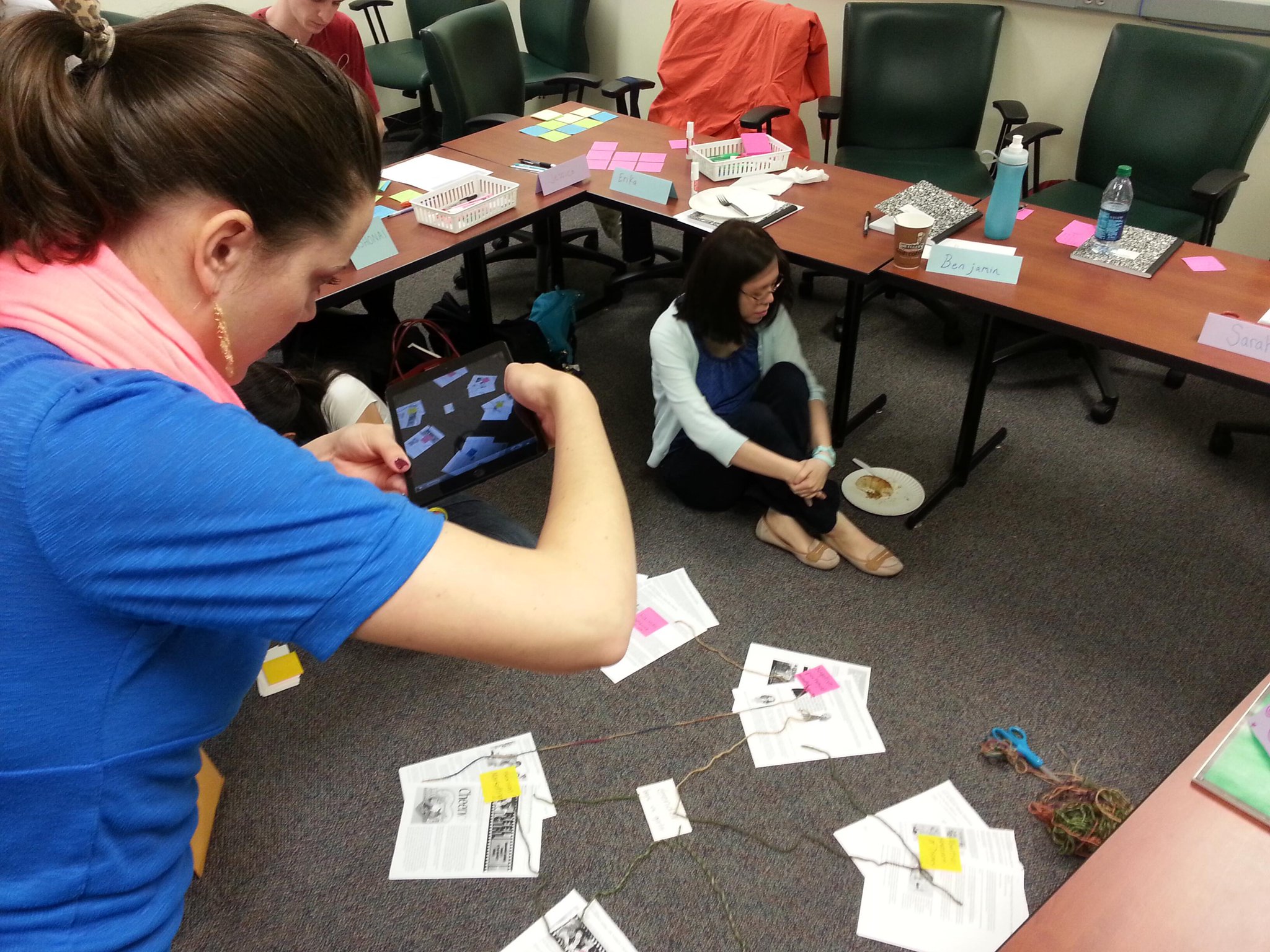
During orientation, making connections seemed like a theme that threaded into each of the demos. Either making these connections physically, like with string ( in the photo below) in Lacy's demo, or representing them spatially on a map, as it worked in both my and Lil's demos.
In documenting, like we will be doing over the course of SI on our blogs and other spaces, it seems like the value of the process comes from the connections we make through it. How when we go back into the pieces we've collected and make sense of them, meaning and learning grows out of the connections the process requires us to make. I have been (and still am) thinking about the value of documenting and reflecting in the inquiry process, and I think that it's this area that I am most excited for this year's Summer Institute.
I am excited to wonder about just which pieces I will hang on to each day and will drive my posts. I am excited to think about the collective story that these short pieces will tell of my learning over the course of the next three weeks. I am excited to think about the points in which my path will intersect with those of others.
And I am excited to, in a year from now, read what I am writing in this space now and realize the significance of what happened in SI in affecting who I am as a thinker, writer, and teacher.
It wasn't until after I began writing this post that I came accros the above exchange, and when I did I was immediately drawn to Tony's remarks about my readiness to make connections, as well as the comments I made about the depth of my wondering. Both of these areas have existed in some form in my thinking about teaching and learning this past year, and I am also seeing these pieces as being important to the work we are doing in SI this year.Tony IannoneJuly 20, 2012 at 6:22 AMWow Steve...thank you for such a deeply thought out reflection on the past 12 days. I must say that you are one of the reasons that I feel my thinking has moved forward during this time. You came to SI...each day...ready to make connections...not in a forceful sort of, "If they're not there...I'm going to make them" kinda way but in a "If they are there...I'll accept them...if they are not...who cares...just enjoy the ride" sort of way. To someone that can be very close minded at times (that would be me) your openness contributed to the things I will take away from this experience...a broadened definition of the ways ideas and knowledge can circulate within and around the classroom. Thank you Steve!ReplyDelete

During orientation, making connections seemed like a theme that threaded into each of the demos. Either making these connections physically, like with string ( in the photo below) in Lacy's demo, or representing them spatially on a map, as it worked in both my and Lil's demos.
In documenting, like we will be doing over the course of SI on our blogs and other spaces, it seems like the value of the process comes from the connections we make through it. How when we go back into the pieces we've collected and make sense of them, meaning and learning grows out of the connections the process requires us to make. I have been (and still am) thinking about the value of documenting and reflecting in the inquiry process, and I think that it's this area that I am most excited for this year's Summer Institute.
I am excited to wonder about just which pieces I will hang on to each day and will drive my posts. I am excited to think about the collective story that these short pieces will tell of my learning over the course of the next three weeks. I am excited to think about the points in which my path will intersect with those of others.
And I am excited to, in a year from now, read what I am writing in this space now and realize the significance of what happened in SI in affecting who I am as a thinker, writer, and teacher.
Subscribe to:
Posts (Atom)